What AI Assistants Say About You (and the Pages They Learn It From)
- Page
- Page 3.4
- Time required
- Time: 20 minutes this week, then 20 minutes a quarter
- Money required
- Cost: $0
- Last reviewed
- Last reviewed 10 Jun 2026
Right now, somewhere in your town, a customer is asking an AI assistant “who’s a good [your trade] near me” — and the assistant is answering, in full sentences, with confidence, whether or not what it says about you is true. You can’t opt out of this. Your only choice is whether you’ve read your own file.
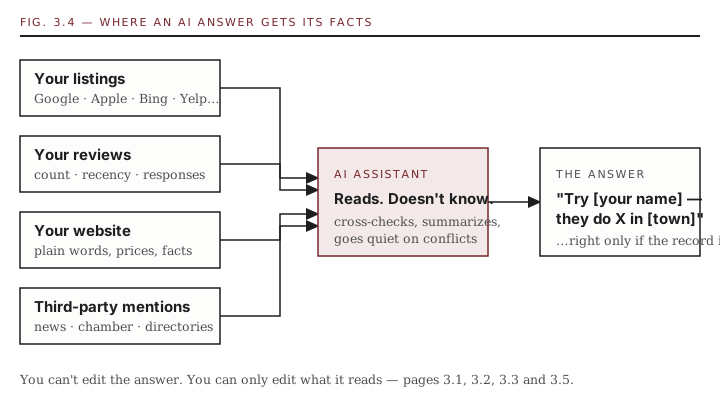
Here’s the mechanic that makes this manageable: the assistant doesn’t know your business. It answers from sources. When someone asks about a local business, the assistant looks things up and summarizes what it finds — and what it finds is, almost entirely, the record this chapter has been building. Your listings. The consistency of your facts across them. Your reviews — their rating, their recency, and what they actually say. Your website’s plain-language pages. And third-party mentions: the local news story, the chamber of commerce member page, the vertical directory for your trade. There is no separate “AI marketing.” There is the record, and there are machines reading it aloud.
Under the hood, briefly
You don’t need the engineering, but knowing roughly where each assistant reads from tells you where to fix things:
- ChatGPT runs a web search under the hood and leans hard on directories — for local recommendations, much of what it cites is third-party sites like Yelp, TripAdvisor, and similar. That unclaimed Yelp page from page 3.1 is being read aloud.
- Gemini is Google’s, and it reads Google’s data: your Business Profile, Maps, and reviews, increasingly as live data rather than memory. Your Google profile is effectively its source of record.
- Copilot reads Microsoft’s index: Bing’s crawl of the web plus Bing Places — the fifteen-minute import you did (or should do) in page 3.1.
Different assistants, same conclusion: the six listings plus your website cover the inputs. The specifics drift — our own quarterly re-runs show which assistant cites which source shifting noticeably within months — which is exactly why you check quarterly instead of memorizing today’s plumbing.
The three lookups
Open any assistant you can get at — ChatGPT, Gemini, Copilot, or whatever is built into your phone — and run these three, filled in for your business. Twenty minutes, this week.
Lookup 1 — the facts check:
What does [business name] in [town] do?You’re checking the boring things: services, hours, phone, area, the description sentence. If a fact is wrong, don’t argue with the chatbot — trace the surface feeding it. Ask the assistant where the information came from, or check its cited links. Then walk the six listings in page 3.1 order until you find the surface that disagrees with your fact sheet. More often than not, the wrong fact is sitting verbatim on a listing you haven’t touched in a year. Fix the source; the assistant follows.
Lookup 2 — the recommendation check:
Who's a good [category] near [town]?You’re in the answer or you’re not. If you’re absent, study who IS recommended. Open the file on two or three of them: How recent is their newest review, and how many do they have? Does their description sentence say plainly what they do and where? Are they on the vertical directory for your trade? You will almost always find they’re simply further along in this chapter — more recent reviews, cleaner facts, one more directory. That’s the gap, and every piece of it is a page you’ve already read.
Lookup 3 — the reputation check:
Is [business name] in [town] any good?This is your reviews, summarized — usually the rating, the volume, and a paraphrase of recurring themes, good and bad. If the themes are wrong or ancient, that’s a recency problem: the steady trickle from page 3.3 is the fix. If the whole answer is stale — your old address, a service you dropped, last year’s hours — understand that assistants lag reality by weeks to months. Fix the source surface now, write the date in your calendar, and re-check next quarter. Staleness isn’t an emergency; it’s a pipeline delay.
Log what you found — even “all three accurate” — because next quarter’s comparison is where drift shows up.
What not to do
This is the part of the chapter where someone will try to sell you something, so here are the defaults:
Don’t buy “AI optimization” packages. When the pitch is stripped of its vocabulary, the deliverable is listings consistency, review velocity, and website copy that states facts plainly — the exact hygiene of pages 3.1 through 3.5, repackaged at $300 a month. You cannot pay to be the answer; you can only be the best-documented option, and you can do that yourself in the hours this chapter already budgeted.
Don’t stuff your site with AI-bait. Pages of “best [trade] in [town]” repeated forty ways, machine-written FAQ farms, walls of text written for robots — assistants summarize meaning, not keyword density, and a site full of filler reads fake to the humans who click through. One honest services page with real prices outperforms ten generated ones.
Don’t try to game it weekly. The answers move slowly because the sources move slowly. Checking weekly is anxiety, not maintenance. Quarterly is the right cadence — it’s already a line item in the quarterly surface check, and the Findability Checkup will flag which surface is most likely feeding any wrong answer. And the time math works in your favor: these twenty minutes a quarter come off the top of time you’d otherwise spend wondering — and they permanently replace every meeting with every vendor whose pitch starts with “AI is changing everything.”
What you control
You cannot control what an AI assistant says about you. There’s no dashboard, no appeal line, no setting. What you control — completely — is the record it reads: six listings that agree with one fact sheet, reviews that arrive steadily and get answered, a website that says plainly what you do, for whom, where.
That’s this whole chapter in one sentence. The assistants didn’t change the job; they raised the price of neglecting it. Every page before this one was building the file. This page is just you, once a quarter, reading it back.
Revision history — this page
- 10 Jun 2026 Quarterly re-run of the three lookups. Updated which assistants cite which sources — answers drifted noticeably since March.